

Table of Contents
- Quick Comparison: Best Sliding Mitts for Youth Baseball
- What to Look for in Youth Sliding Mitts
- Benefits of Baseball Sliding Mitts for Young Players
- Top Drip & Rip Sliding Mitts for Youth Baseball
- How to Wear a Sliding Mitt Correctly
- Youth Baseball Protective Gear: Where Sliding Mitts Fit In
- Sizing Guide for Youth Players
- Cleaning and Maintaining Your Sliding Mitt
- Frequently Asked Questions
Last Updated: September 13, 2026
Quick Comparison: Best Sliding Mitts for Youth Baseball
The best sliding mitts for youth baseball come down to three things: impact protection, wrist security, and a fit that survives a full season of headfirst slides.
Jammed fingers and hand injuries are common setbacks for young base runners, and the lead hand takes the worst of it on every steal (The Epidemiology and Effect of Sliding Injuries in Major and Minor League Baseball Players).
Below: which features separate a durable mitt from one that falls apart, how to size it for ages 10-13, and how to wear it so it stays locked on at full speed.
Quick Picks:
- Best Overall: Drip & Rip Sliding Mitt Magma ($54), dual protective plates, Drip-Lock™ wrist strap, adult and youth sizing
- Best Value: Drip & Rip Sliding Mitt Limelight ($39), same protection, lowest price in the lineup
- Best Statement Colorway: Drip & Rip Sliding Mitt Danger Zone ($59), electric volt-yellow, reinforced fingertip protection
| Mitt | Price | Sizing | Standout Feature |
|---|---|---|---|
| Limelight | $39.00 | Adult / Youth (10-13) | Lowest price, neon yellow |
| Magma | $54.00 | Adult / Youth (10-13) | Fiery red-orange, dual plates |
| Vice Vice Baby | $54.00 | Adult / Youth (10-13) | Teal and pink colorway |
| Flags | $54.00 | Adult / Youth (10-13) | Red, white and blue |
| Cotton Candy | $54.00 | Adult / Youth (10-13) | Pastel pink and blue |
| El Tigre | $54.00 | Adult / Youth (10-13) | Tiger-stripe pattern |
| Pinstripes | $54.00 | Adult / Youth (10-13) | Classic pinstripe |
| Waverunner | $54.00 | Adult / Youth (10-13) | Wave-inspired blue |
| Freezer Burn | $54.00 | Adult / Youth (10-13) | Icy blue and white |
| Danger Zone | $59.00 | Adult / Youth (10-13) | Electric volt-yellow |
What to Look for in Youth Sliding Mitts
A youth sliding mitt earns its place on four criteria: impact resistance, wrist stabilization, fingertip coverage, and a closure system that does not loosen mid-slide. Most parents shop colorway first, which is backwards: a loose fit turns protection into a liability.

Impact Resistance and Finger Protection
Protection starts with dual impact protective plates covering the top and underside of the hand, since headfirst slides expose both surfaces. Reinforced fingertip protection matters just as much, because fingers catch the bag edge on late slides.
Wrist Stabilization and Secure Fit
A sliding mitt that shifts on contact stops protecting anything. The closure system decides this.
Hook and loop straps hold firm when new but can lose grip with dirt and sweat. Elastic compression straps keep tension across the whole slide. Drip & Rip's Drip-Lock™ velcro wrist strap is designed to provide a secure fit.

Benefits of Baseball Sliding Mitts for Young Players
What Actually Happens to the Lead Hand
On a headfirst slide, the lead hand hits the base or ground first, at speed. Three injury patterns recur in youth baseball:
- Jammed fingers. The fingertips catch the edge of the bag or a cleat on a late slide. The finger compresses lengthwise into the joint, which is where jammed knuckles and, in worse cases, finger fractures come from (Mallet Finger - OrthoInfo).
- Hyperextension of the wrist. When the hand plants and the body keeps moving, the wrist bends backward past its normal range. This is the mechanism behind wrist sprains and, less often, scaphoid injuries, which are notoriously slow to heal in young athletes (A review of scaphoid fracture, treatment outcomes, and consequences).
- Abrasion and contusion on the back of the hand. The back of the hand drags across infield dirt and the base surface. Bare skin loses that exchange every time.
A sliding mitt addresses all three: dual impact protective plates cover the top and underside of the hand, reinforced fingertip protection can absorb the lengthwise compression that jams fingers, and the wrist strap plus elastic compression strap can limit wrist hyperextension on contact.

Why Protection Changes How Players Slide
The second benefit is behavioral. Young runners who do not trust their hands may slide feet-first, or slide late and pull up. A player who trusts the lead hand may commit to the headfirst slide earlier and slide harder, which can lead to more stolen bases and scoring opportunities. The mitt does not make a player faster; it can help remove hesitation.
Durability Across a Season
A mitt built with a durable shell and stitching can outlast bare hands, athletic tape, and some alternatives. Tape may not stay put once sweaty and dirty, and it offers no impact protection. For travel ball families, a mitt that survives a full season can be a cost-effective alternative to replacing tape every tournament.
The Benefit Parents Underestimate: Hygiene
A sliding mitt is on the lead hand for every stolen base attempt, so it collects sweat and infield dirt. A washable shell and rinseable strap keep that grime off the hand and out of the glove bag. Hand wash in cool water with mild soap after every few games, rinse the wrist strap, and air dry away from direct heat.
Top Drip & Rip Sliding Mitts for Youth Baseball
Drip & Rip builds one sliding mitt platform across ten colorways, all sharing the same core construction: dual impact protective plates, Drip-Lock™ velcro wrist strap, elastic compression strap, reinforced fingertip protection, and one-size-fits-most sizing in adult and youth (ages 10-13). Only colorway and price differ.
Every model fits the left hand for right-handed sliders.
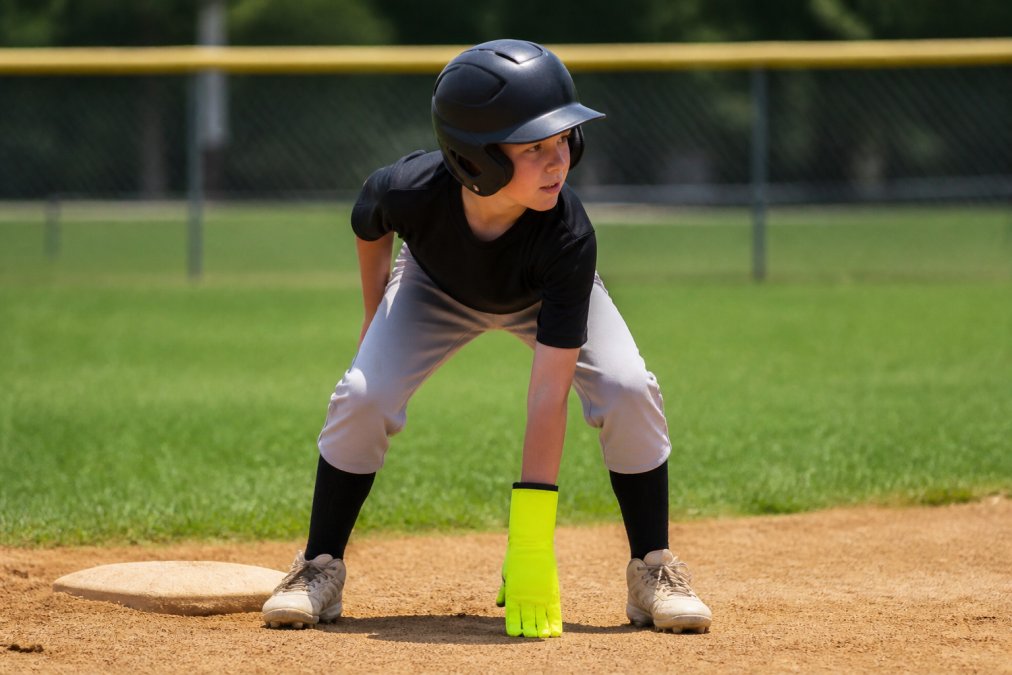
Drip & Rip Sliding Mitt Limelight
The Limelight is the value pick at $39.00: high-vis neon yellow, with dual plates and a Drip-Lock™ strap. It may show dirt faster than darker patterns, so expect to wash it more often.
Buy the Limelight as a backup mitt. At $39, keeping a second one in the bag costs less than missing a tournament because a strap gave out.
Drip & Rip Sliding Mitt Magma
The Magma runs $54.00 in a fiery red and orange colorway with an embroidered Drip & Rip badge.
The honest limitation: red and orange read as team colors on some uniforms, so it is less of a statement piece than the louder options.
Drip & Rip Sliding Mitt Danger Zone
At $59.00, the Danger Zone is electric volt-yellow with reinforced fingertip protection. You are paying for the colorway, since specs match the $54 mitts.
How to Wear a Sliding Mitt Correctly
Wear the sliding mitt on your lead hand, the hand that hits the base first. For a right-handed slider, that is the left hand, which is why every Drip & Rip mitt is built for the left.
Four steps to a correct fit:
- Slide the mitt onto the lead hand with fingers fully extended into the reinforced tips.
- Tighten the Drip-Lock™ velcro wrist strap until it sits snug against the wrist bone.
- Confirm the elastic compression strap is seated flat, not twisted.
- Make a fist, then open the hand. The mitt should stay put through both movements.
If the mitt shifts during that test, tighten the strap before stepping on the field.
Youth Baseball Protective Gear: Where Sliding Mitts Fit In
Youth baseball protective gear covers batting helmets, elbow guards, chest protection, and sliding mitts. The sliding mitt is a piece of gear that protects the hand on the play where hands are most exposed.
A complete setup for a competitive youth player looks like this:
- Batting helmet with face guard
- Elbow guard on the lead arm
- Sliding mitt for the lead hand
- Cup and sliding shorts
The sliding mitt is an item on that list protecting against base-path hand injuries specifically, and is available from $39 to $59.
Sizing Guide for Youth Players
Sizing is where most sliding mitt purchases go wrong. A sliding mitt is not sized like a batting glove: batting gloves go by hand length, while sliding mitts combine hand length, wrist circumference, and how much strap adjustment is left. Get it wrong and the mitt either slides off on contact or pinches the wrist until a player stops wearing it.
Here is the mapping that matters for youth players:
| Age Band | Typical Hand Length | Recommended Size | Notes |
|---|---|---|---|
| 6-9 | 5.0-5.75 in | Youth (smallest strap setting) | Most players in this band may be better served by a youth mitt tightened fully than by an adult mitt |
| 10-13 | 5.75-6.75 in | Youth | The core youth range; strap should tighten with room to spare |
| 13-15 | 6.75-7.25 in | Youth or Adult (boundary) | Measure before deciding; see boundary rule below |
| 16+ | 7.25 in and up | Adult | High school, college, and adult league |
Measure hand length from the base of the palm to the tip of the middle finger, hand flat, and wrist circumference just below the wrist bone. Write both numbers down before you shop.
The Boundary Rule
At the youth/adult line, the deciding factor is strap range, not hand length. A youth mitt on a 13-year-old with a 6.75-inch hand fits if the strap still has adjustment left when tightened; an adult mitt fits if the strap tightens down without the shell bunching at the wrist. Parents may buy adult size for a 12-year-old to "get more seasons out of it," but if the mitt shifts on the first headfirst slide, the player may stop wearing it. A correctly sized youth mitt that lasts one season can be more effective than an oversized adult mitt that is not used.
Three Fitting Tests Before You Keep It
Run these before the tags come off:
- The fist test. Make a fist, then open the hand. The mitt should stay seated through both movements without the wrist strap riding up.
- The fingertip test. Fingers should reach the reinforced tips with the hand fully extended, not curled. If the fingers curl to reach the tips, the mitt is too long.
- The strap-range test. Tighten the wrist strap until it sits snug against the wrist bone. You should have at least a half-inch of strap left before the end of its range. If you are at the end of the range, the mitt is too big.
Left Hand, Right Hand, and Switch Sliders
Every Drip & Rip mitt is built for the left hand, the lead hand for a right-handed slider. If your player slides right-hand-first or is a switch slider, check the listing before buying: a left-hand mitt puts protection on the wrong hand.
When to Replace a Mitt Instead of Resizing
A mitt that fit in March can feel loose by August if the elastic compression strap stretched or the hook and loop packed with dirt. Before buying a new size, wash the wrist strap, dry it fully, and re-run the strap-range test. If the strap recovers its grip, it is a maintenance problem, not a sizing problem. If the elastic has lost tension permanently, replace the mitt.
Cleaning and Maintaining Your Sliding Mitt
A sliding mitt survives a season on three habits: wash by hand, dry out of the sun, and check the strap before every tournament.
Dirt is the enemy of hook and loop closure: once grit works into the strap, it stops holding tension and the mitt shifts on contact.
A simple maintenance routine:
- Hand wash in cool water with mild soap after every few games
- Rinse the wrist strap specifically to clear out infield dirt
- Air dry away from direct heat and sunlight
- Check the velcro holds firm before each game
- Inspect the stitching around the plates once a month
Skip the washing machine. Heat and agitation break down the elastic compression strap and shorten the mitt's life.
The gap between a protected hand and a jammed finger can be addressed with one piece of gear. Drip & Rip builds sliding mitts with dual impact protective plates, the Drip-Lock™ velcro wrist strap, and reinforced fingertip protection across ten colorways, in youth sizing for ages 10-13 and adult sizing for teens and up, from $39 to $59. Free shipping applies on orders $75 and up, so pairing a mitt with batting gloves clears the threshold. Get started with Drip & Rip and slide into the season with your lead hand covered.
Frequently Asked Questions
Are sliding mitts necessary for youth baseball?
They are not required by rule, but they significantly reduce the risk of jammed fingers and hand injuries during headfirst slides. Young players learning proper sliding technique can benefit because their hands are still developing and they may not yet judge the base path perfectly. A sliding mitt adds a protective layer without restricting movement.
How do I choose the right size sliding mitt for my child?
Most youth sliding mitts, including Drip & Rip models, are designed as one size fits most for the left hand. The youth fit works for ages 10 to 13, while the adult fit works for teens and up. Check the product page for age recommendations and measure your child's hand from wrist to fingertip to confirm.
How do you clean a baseball sliding mitt?
Hand wash with mild soap and cold water, then air dry completely before the next game. Avoid machine washing and direct heat, which can break down the protective plates and weaken the hook and loop closure. For tough dirt on the shell, use a soft brush. Regular cleaning keeps the material breathable and extends the life of the mitt.
Do sliding mitts help prevent finger injuries?
Yes. The reinforced fingertip protection and dual impact plates on quality sliding mitts can absorb force when the hand hits the ground or the bag. This can reduce the chance of jammed fingers, fractures, and scrapes during headfirst slides. The wrist strap also stabilizes the hand to help prevent it from bending awkwardly on impact.
Can softball players use the same sliding mitts as baseball players?
Yes. Drip & Rip sliding mitts are built for both baseball and softball. The dual impact plates, Drip-Lock wrist strap, and one-size-fits-most design work the same regardless of sport. The main difference is colorway preference, and Drip & Rip offers bold options like Vice Vice Baby and Cotton Candy that appeal to softball players.


